





100- 01/05/2026- During a recent trip to China: reflections on empowerment in a country where everyone is under surveillance. Contemporary China has gradually organized itself around omnipresent system of social control, where every behavior seems to be observed, anticipated, and corrected. Deployed on a national scale through digital technologies, video surveillance, and artificial intelligence, this surveillance frenzy makes Chinese society a striking—almost caricatural—illustration of Michel Foucault’s thinking, while also evoking, in a disturbing way, the totalitarian world imagined by George Orwell in 1984. Behind the apparent efficiency of the Chinese model lies an essential question: what becomes of individual and collective autonomy in a society where control tends to become permanent?
In the streets as well as in public parks, clusters of cameras capture the slightest movement. Even inside vehicles, several monitoring systems coexist: one camera aimed at the driver and guide, another at the passengers, not to mention those dedicated to traffic surveillance, along with embedded sensors. Combined with facial recognition and artificial intelligence, the system appears to operate continuously, ready to detect the slightest deviation.
“Smile, you’re being filmed”—except that here, the message takes on a different meaning: “Above all, don’t smile!” because if a camera is pointed at you, it means you are considered potentially suspicious. An effective system, according to Qi Yanjun, China’s Vice Minister of Public Security, who proudly declared on July 23, 2025, that China is widely recognized as one of the safest countries in the world. (1)
But this efficiency comes at a price: the internalization of control.
Faced with this permanent “eye” constantly watching them, people adjust their behavior. An almost Pavlovian reflex takes hold: one self-corrects before even transgressing. Do not run. Do not step out of line. Do not improvise. As early as 1975, Foucault described this diffuse form of power, whose “strength lies in the fact that it never intervenes”—because it has already been internalized by individuals themselves.
The comparison with our own practices is revealing: in France, drivers slow down when approaching a speed camera. In China, the camera is everywhere—and it is not only interested in your speed. During our stay in Yunnan, a Le Monde article dated April 21, 2026, reported the case of a cyclist fined through facial recognition for riding a few dozen meters on a sidewalk in order to save time.
This constant “reframing” does more than regulate behavior: it shapes mindsets. It instills a lasting aversion to unpredictability, risk, and any form of deviation. Even leisure activities bear its mark. Horseback rides offered to adults are conducted strictly at walking pace, with someone holding the reins. The goal: zero risk. The result: zero freedom—and very often zero pleasure.
Under such conditions, speaking of empowerment almost becomes a paradox. Empowerment presupposes precisely the possibility of stepping aside, deciding for oneself, experimenting, making mistakes—in other words, exercising real power over one’s own trajectory.
Yet the culture of control also infiltrates human relationships. The manager of our travel agency responded instantly to the slightest request, with impressive efficiency. But such hyper-responsiveness raises doubts: could our requests have consequences for local guides if their services were judged unsatisfactory? Behind the demand for service quality hovers an invisible and diffuse pressure.
And yet, even within this highly structured system, forms of micro-resistance emerge.
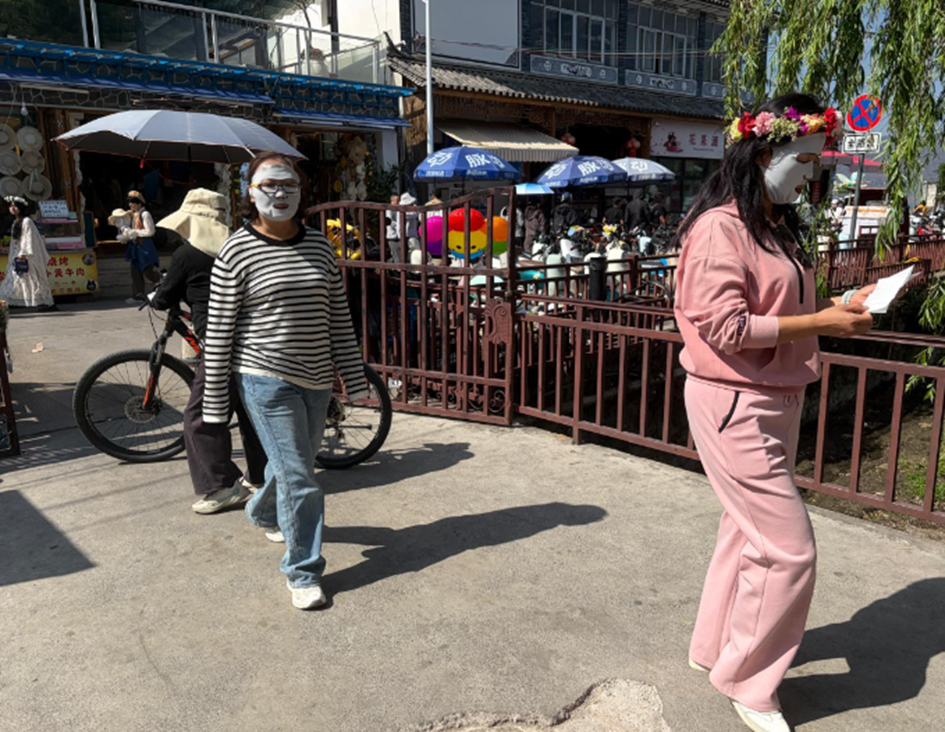
Many young people—women and men alike—wear masks that completely cover their faces, sometimes flesh-colored. Officially, they protect against the sun. Unofficially, they also disrupt facial recognition systems. A discreet way of reclaiming some control over one’s identity. Like a silent response: “I am watching you while you watch me—and you do not recognize me.”
Perhaps this is where a form of empowerment still survives: in these cracks within the system, these adjustments, these avoidance strategies that allow individuals to preserve a measure of independence while outwardly accepting the framework imposed upon them.
One central question remains: what does a regime of permanent social control ultimately produce? When individuals internalize norms to the point of censoring themselves before even acting, what becomes of creativity, initiative, and the capacity to free oneself from an overly constraining framework? In seeking to eradicate every form of deviation, the security logic ultimately weakens what gives human and collective life its vitality: independent thought, unpredictability, a touch of madness, critical thinking, disagreement, and the capacity to imagine alternative possibilities.
How far can a society accept the systematic exploitation of personal data—without transparency regarding its political or economic uses, without genuine checks and balances, without safeguards or guarantees?
The issue goes far beyond the defense of individual liberties or the protection of privacy. It touches the very foundation of collective trust. A society placed under permanent surveillance also risks becoming a society of distrust, where people conform—or pretend to conform—more than they truly participate. Order ultimately suffocates the vital impulse, that subversive spark which makes existence lighter, fuels the desire to act together, and gives collective life its creative force.
Without the right to step out of line, there can be neither autonomous individuals nor a truly living society.
Marie-Georges Fayn
(1) Mr. Qi made this statement regarding achievements in the field of public security during the 14th Five-Year Plan period (2021–2025), at a press conference organized by the State Council Information Office. According to Mr. Qi, public security authorities have made a significant contribution to facilitating China’s high-quality development by resolutely safeguarding public safety. Thanks to their efforts, China has maintained one of the lowest rates of fatal criminal cases, the lowest rates of criminal offenses, and the fewest cases involving firearms and explosives.
https://french.xinhuanet.com/20250723/32a9f7346f484b55900ce31691542d21/c.html
(2) Foucault, M. (1975). Discipline and Punish: The Birth of the Prison. Paris: Gallimard, “Bibliothèque des Histoires.”
En postant un commentaire sur www.selfpower-community, vous acceptez les règles de l’espace réaction et reconnaissez à www.selfpower-community la capacité de ne pas publier certaines contributions sans avoir à motiver cette décision.
prendre connaissance des règles